USM is a Swiss family-owned company based in Münsingen near Bern. Its history began in 1885, when Ulrich Schärer founded a hardware and metal workshop. Originally, the company did not manufacture furniture, but rather developed and produced metal products and window hardware. It wasn’t until the 1960s that the fusion of architecture, technology, and industrial production gave rise to the furniture system for which USM is known worldwide today.
It all began with the collaboration between Paul Schärer Jr. and the Swiss architect Fritz Haller. Haller designed a new, flexibly expandable factory and administrative building for USM. The modular principle of the architecture was subsequently applied to the office furnishings. Based on this idea, Schärer and Haller developed a furniture system consisting of steel tubes, connecting spheres, and metal panels. The USM Haller System was patented in 1965 and was initially used in the company’s own offices.
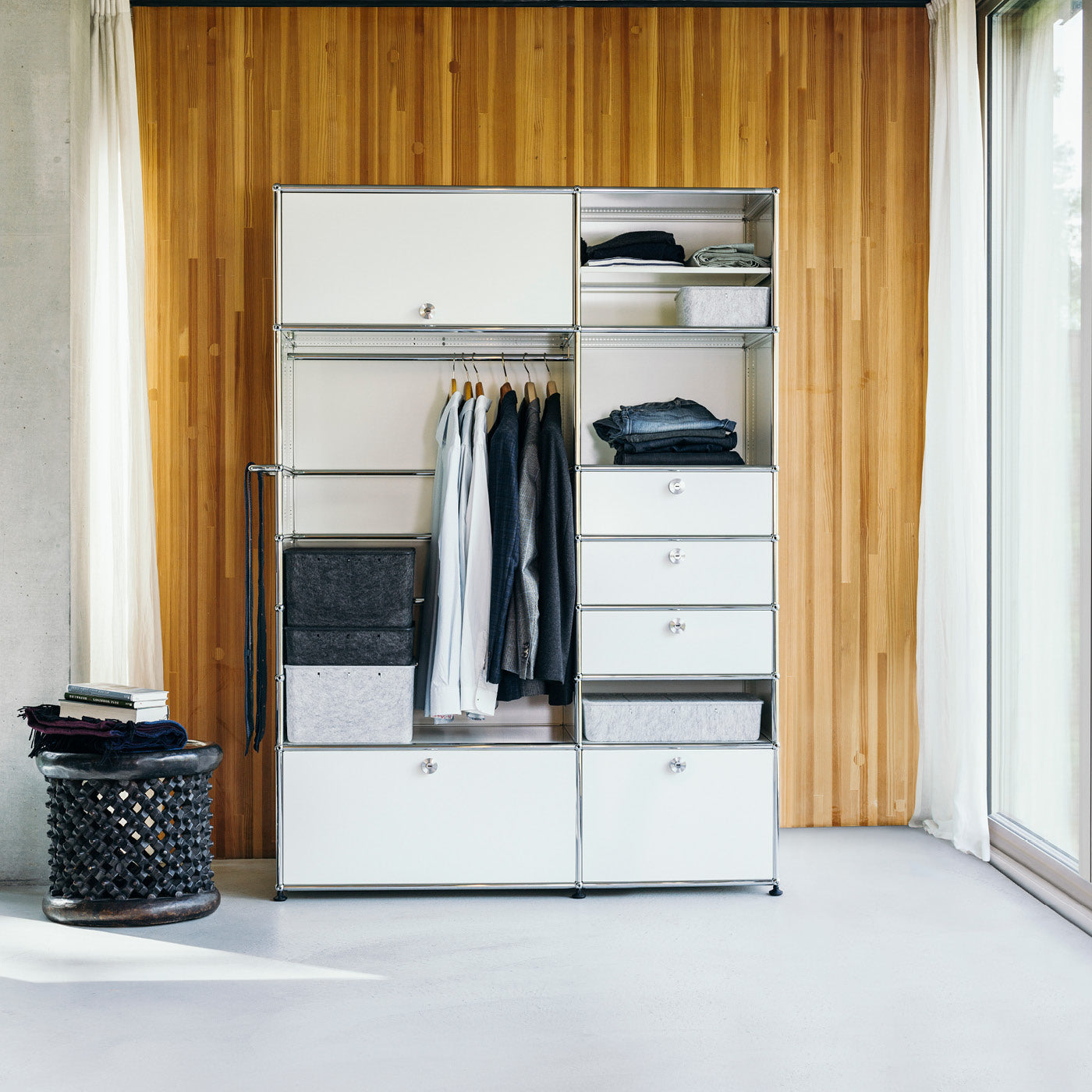
The central structural element is a chrome-plated ball with six threaded holes. It connects the chrome-plated steel tubes to form a sturdy grid into which powder-coated metal panels, doors, hinged doors, pull-outs, shelves, and glass elements can be inserted. This clearly defined design principle allows for a wide variety of forms and functions without altering the system’s characteristic aesthetic.
USM Haller can be configured as a small accent piece, nightstand, sideboard, lowboard, bookshelf, display cabinet, filing cabinet, or space-defining structure. The furniture is suitable for living rooms, dining areas, bedrooms, home offices, offices, stores, hotels, and public buildings. A variety of sizes, doors, pull-outs, open compartments, and colors allow for customization to suit the specific space and intended use.
A key advantage is its long-term adaptability. The furniture can be disassembled, inspected, and reassembled using existing or new components. For example, a low sideboard can later be transformed into a taller shelf, a cabinet, or a larger media solution. As a result, the system adapts to changing living situations, workflows, and spatial requirements without the need to replace the entire piece of furniture.
In addition to the classic USM Haller system, the product line includes other solutions. USM Haller E integrates dimmable lighting and USB ports into the furniture structure in a nearly invisible way. Plant elements allow for the integration of houseplants, while Lock C provides an electronically controlled locking mechanism for storage spaces. The collection is complemented by USM Haller tables and the height-adjustable USM Kitos desks for ergonomic workspaces.
Its minimalist design, featuring clean lines, chrome-plated steel, and colored metal surfaces, makes USM Haller a versatile design classic. The system was recognized as a work of applied art in Switzerland in 1988 and was added to the permanent collection of the Museum of Modern Art in New York in 2001. Despite its iconic status, it remains functional and can be continuously adapted to new requirements.
At USM, sustainability is achieved primarily through long-term use. Wear-resistant materials, timeless colors, interchangeable components, and the system’s backward compatibility are designed to enable use across multiple generations. The furniture is custom-designed and manufactured, which helps reduce overproduction and unnecessary material use. In addition, the brand supports the established secondhand market for USM furniture.
USM is ideal for people who don’t just buy furniture to fit their current living situation, but view it as a long-term, adaptable furnishing system. The combination of Swiss precision, architectural clarity, and enduring modularity makes USM Haller the perfect solution for both residential and professional spaces.